Why Is Medicai the Best for Deep IT Integration?
Many hospitals run separate systems for imaging retrieval, storage, and sharing, so staff spend hours moving files between tools. These hand-offs create delays when a radiologist needs prior scans or a specialist needs urgent access. The result is slower care and higher risk of missing critical images.
By the end of this article you will see exactly how Medicai combines those functions into one cloud platform, what each module handles, and which care settings gain the most from replacing multiple vendors with a single contract.
What Is Medicai?
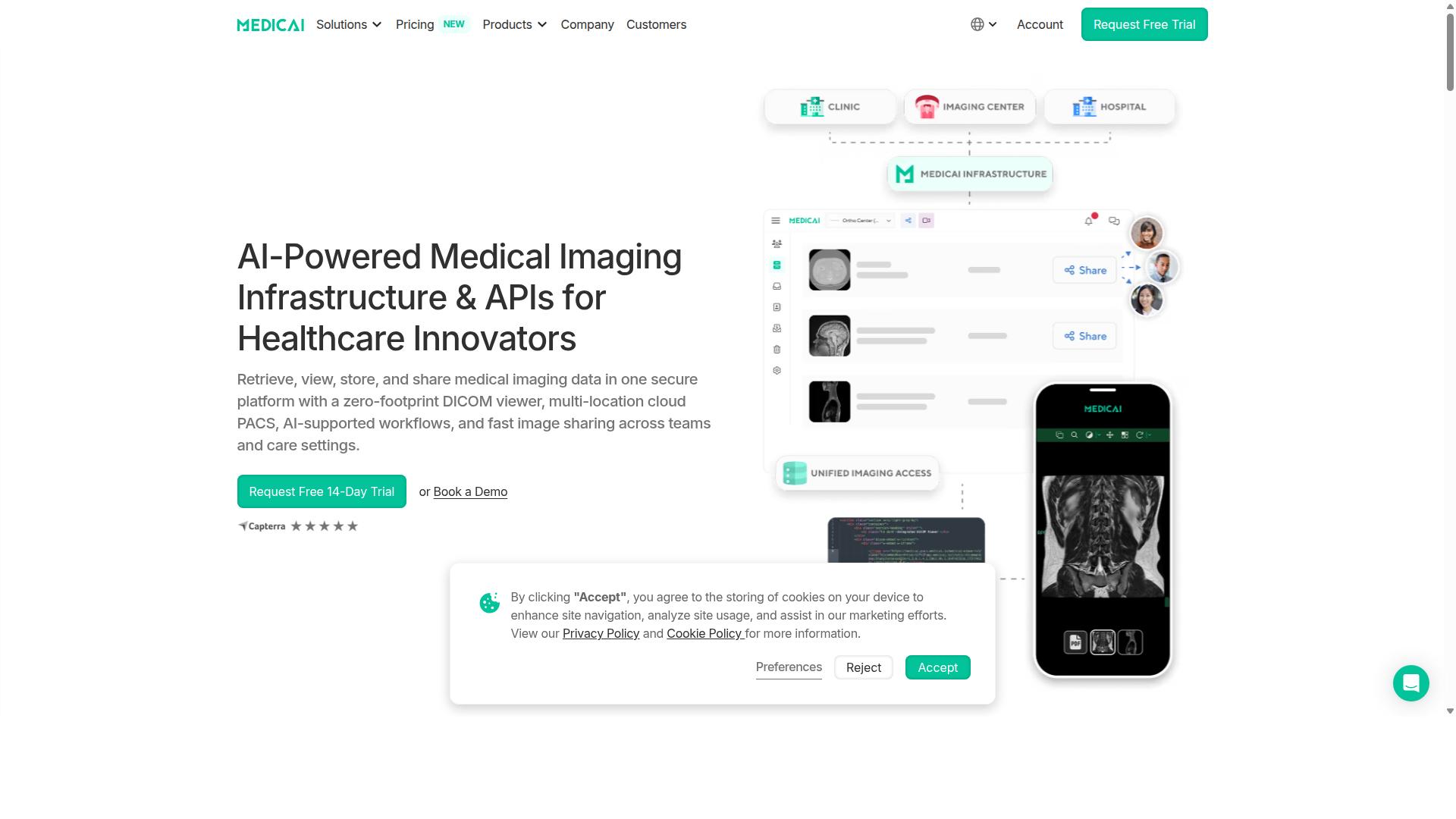
Medicai is a cloud-based medical imaging platform that centralizes retrieval, viewing, storage, and sharing of medical imaging data.
The platform runs as a zero-footprint DICOM viewer that needs no local software installation. This design removes hardware dependencies and allows quick deployment across hospital networks.
Multi-location cloud PACS support lets teams access studies from any connected site without data duplication. A single secure workspace brings together radiologists, cardiologists, and referring physicians.
Medicai offers Imaging Infrastructure as a Service through its vendor-neutral archive. The service supports teleradiology workflows and cross-institutional sharing while maintaining HIPAA compliance and GDPR requirements.
AI-supported workflows are built into the platform and connect with existing EHR and EMR systems. RESTful endpoints and an API-first architecture enable deep IT integration with hospital networks.
Why Medicai Excels at Deep IT Integration
Deep IT integration in medical imaging platforms eliminates data silos by embedding imaging workflows directly into existing clinical systems. API-first architecture allows healthcare organizations to connect imaging tools with their current infrastructure without major disruptions. This approach supports seamless data exchange across departments.
RESTful endpoints form the foundation of this connectivity. These endpoints enable developers to build custom integrations that pull imaging data, patient records, and reports into unified workflows. Healthcare teams benefit from consistent access to critical information across different software environments.
HL7 and FHIR compatibility ensures medical imaging systems sync with EHR and EMR platforms. This standard-based approach allows patient demographics, orders, and results to flow automatically between systems. Real-time synchronization reduces manual data entry and minimizes errors.
Container-based microservices provide the technical backbone for scalable deployment. These services isolate specific functions like image processing, routing, and storage. Organizations gain flexibility to scale individual components based on clinical demand without affecting the entire platform.
The microservices model supports both on-premise and cloud environments. Medical imaging departments can maintain data security while enabling cross-institutional sharing. This architecture reduces latency and supports high-volume radiology, cardiology, and oncology workflows.
Key Features and What Makes Medicai Stand Out
The platform's feature set spans three interconnected layers that handle the complete imaging lifecycle.
Medical imaging departments face ongoing pressure to maintain seamless data flow across multiple systems. Deep IT integration requires more than surface-level connections between platforms.
Medicai addresses these challenges through a structured approach that prioritizes interoperability at every level. The platform supports DICOM, HL7, and FHIR standards while maintaining HIPAA compliance and GDPR requirements.
This architecture enables healthcare organizations to connect existing infrastructure without replacing current investments. The result supports workflow automation across radiology, cardiology, and oncology departments.
CONNECT & RETRIEVE Capabilities
The CONNECT & RETRIEVE layer provides Medical Imaging Uploader and DICOM Gateway tools that pull studies from any source into the platform.
The Medical Imaging Uploader supports drag-and-drop workflows for manual study transfers. This reduces manual steps when importing external imaging data.
The DICOM Gateway performs auto-polling from modalities to capture studies automatically as they are generated. This eliminates delays between image acquisition and system availability.
Cross-institutional image exchange handles transfers between different healthcare facilities. The system applies bandwidth optimization and lossless compression to maintain image quality while managing network resources efficiently.
STORE & MANAGE Infrastructure
STORE & MANAGE infrastructure consists of Cloud PACS, Vendor Neutral Archive, and automated backup systems that maintain data integrity.
The Cloud PACS scales to support 1.7M+ studies while maintaining consistent performance. This capacity handles growing imaging volumes without infrastructure changes.
The Vendor Neutral Archive standardizes data from multiple vendors into a unified format. This removes dependency on proprietary systems and simplifies future migrations.
Patient Case Management folders organize studies by patient records for quick retrieval. Daily encrypted backups with disaster recovery SLAs protect against data loss and support business continuity requirements.
ACCESS, VISUALIZE, COLLABORATE Tools
ACCESS, VISUALIZE, COLLABORATE tools enable instant viewing, secure sharing, and real-time team interaction across locations.
The zero-footprint DICOM Viewer operates in any browser without software installation. This reduces IT overhead while maintaining full imaging functionality.
Role-based access controls combined with automated workflow routing direct studies to appropriate team members. Multi-user annotations allow simultaneous review and documentation across different locations.
These capabilities support teleradiology workflows and tumor board presentations. The platform handles 300k+ visualizations per year while maintaining security standards and audit requirements.
Pricing and Plans
Medicai offers tiered monthly subscriptions that scale storage and connected locations without per-user fees. The platform serves medical organizations that need predictable costs tied to actual infrastructure use rather than headcount.
Starter begins at $249 per month. This tier includes 500 GB of cloud storage and unlimited user accounts with no connected locations. Organizations can test these capabilities through a 14-day trial that requires no credit card.
Standard costs $749 per month. It provides 2 TB of cloud storage, unlimited user accounts, and one connected location. Both tiers avoid per-user charges so teams can expand without budget surprises.
Yearly billing reduces these rates by 15 percent. Starter drops to $209 per month and Standard to $639 per month when paid annually. Enterprise customers receive custom pricing based on storage needs and the number of external locations.
Each connected location requires a $1,000 one-time DICOM Gateway setup fee. This structure supports deep IT integration by aligning costs with actual deployment scale rather than licensing complexity.
Trust Signals
Security and compliance certifications demonstrate that the platform meets stringent healthcare data protection requirements. HIPAA and GDPR compliance ensure patient information remains protected across all system interactions.
Additional clearances include FDA and CEE cleared viewers that validate diagnostic capabilities. These clearances confirm the platform meets regulatory standards for medical imaging workflows.
Processing volume reflects security infrastructure strength. 50M+ yearly API transactions operate under zero-trust security frameworks that prevent unauthorized access.
Full audit trail logging creates detailed records of every system interaction. This documentation supports compliance reporting and security investigations when required.
OWASP security guidelines form the foundation for continuous protection measures. These standards guide ongoing security assessments and vulnerability management practices.
Who Should Use Medicai
Hospitals, imaging centers, and specialty practices handling high imaging volumes benefit most from centralized access and reduced infrastructure costs.
Radiology departments rely on vendor-neutral archive capabilities. They store and retrieve studies across multiple modalities while maintaining consistent protocol standards.
Cardiology practices integrate deep IT integration with existing equipment. This connection allows seamless transfer of imaging data between cath labs and reporting systems.
Oncology centers coordinate tumor board reviews. Cross-institutional sharing enables specialists to access complete imaging histories regardless of where studies originated.
Orthopedics and neurology clinics manage longitudinal patient records. Real-time synchronization keeps imaging data current across different care locations.
Teleradiology groups face unique workflow demands. Scalable vendor-neutral storage supports reading from multiple hospital systems without requiring separate infrastructure at each site.
Multi-site hospital systems need consistent data management across facilities. Multi-tenant architecture maintains security boundaries while enabling authorized users to access studies from any location.
Patients access their imaging through the Patient Portal. This direct connection reduces administrative burden on staff while giving individuals immediate access to their medical records.
Final Verdict
Medicai delivers a production-ready, API-first medical imaging platform that reduces on-premise hardware while maintaining full clinical interoperability. The system scales to support 1M+ studies per year across healthcare organizations that require reliable performance.
Global availability comes from two established locations. Medicai USA operates at 7901 4th St N, STE 300, St. Petersburg, FL, 33702 with phone support at +1 (832) 220 1035. Medicai Romania maintains operations at 53-55 N Filipescu, 5th Floor, Sector 2, Bucharest, 020961 reachable at +40 316 305 875.
Healthcare teams seeking deep IT integration benefit from this distributed presence. Regional teams gain direct access to technical resources and implementation guidance without geographic barriers.
Sales inquiries and implementation discussions can be directed to [email protected]. The contact channel connects organizations with specialists who evaluate specific integration requirements and deployment timelines.
Both locations maintain the same API-first architecture and cloud-native platform. This consistency ensures that organizations receive identical capabilities regardless of which regional office they contact first.
Recommended Resources: