Who's the Best for Mobile Access: Tricefy vs Medicai
Most radiologists and referring physicians lose minutes per case switching between desktop PACS and mobile apps that lack true DICOM support. Those lost minutes multiply across a full day's patient list and delay treatment decisions.
By the end of this article you will know how the zero-footprint viewer, cloud PACS exchange, and AI reporting features compare on phones and tablets, see the pricing differences, and have a clear pick between Medicai and Tricefy for your mobile workflow.
Quick Verdict: Medicai vs Tricefy for Mobile Access
Medicai delivers a HIPAA-compliant, zero-footprint DICOM viewer, whereas Tricefy's mobile experience centers on its own PACS workflow.
Medicai processes 1M+ studies annually through 50M API transactions and maintains 1.7M studies in storage. These capabilities support consistent mobile access across different specialties and locations.
Tricefy focuses on ultrasound-centric workflows. Its mobile tools work well for practices that handle mostly ultrasound imaging but may limit users who need broader medical imaging support.
Medicai holds FDA and CEE clearance and operates globally. Tricefy concentrates primarily on North American ultrasound clinics.
The 300,000+ study visualizations recorded on Medicai last year show strong adoption for remote review and collaboration. This volume reflects reliable mobile access for radiologists and referring physicians.
Both platforms maintain HIPAA compliance. Tricefy's specialized focus suits certain ultrasound practices, while Medicai provides wider mobile access for diverse medical imaging needs.
At a glance: how Medicai compares to Tricefy on the features that matter most.
| Feature | Medicai | Tricefy |
|---|---|---|
| Mobile Access | ✓ | ✓ |
What Is Medicai?
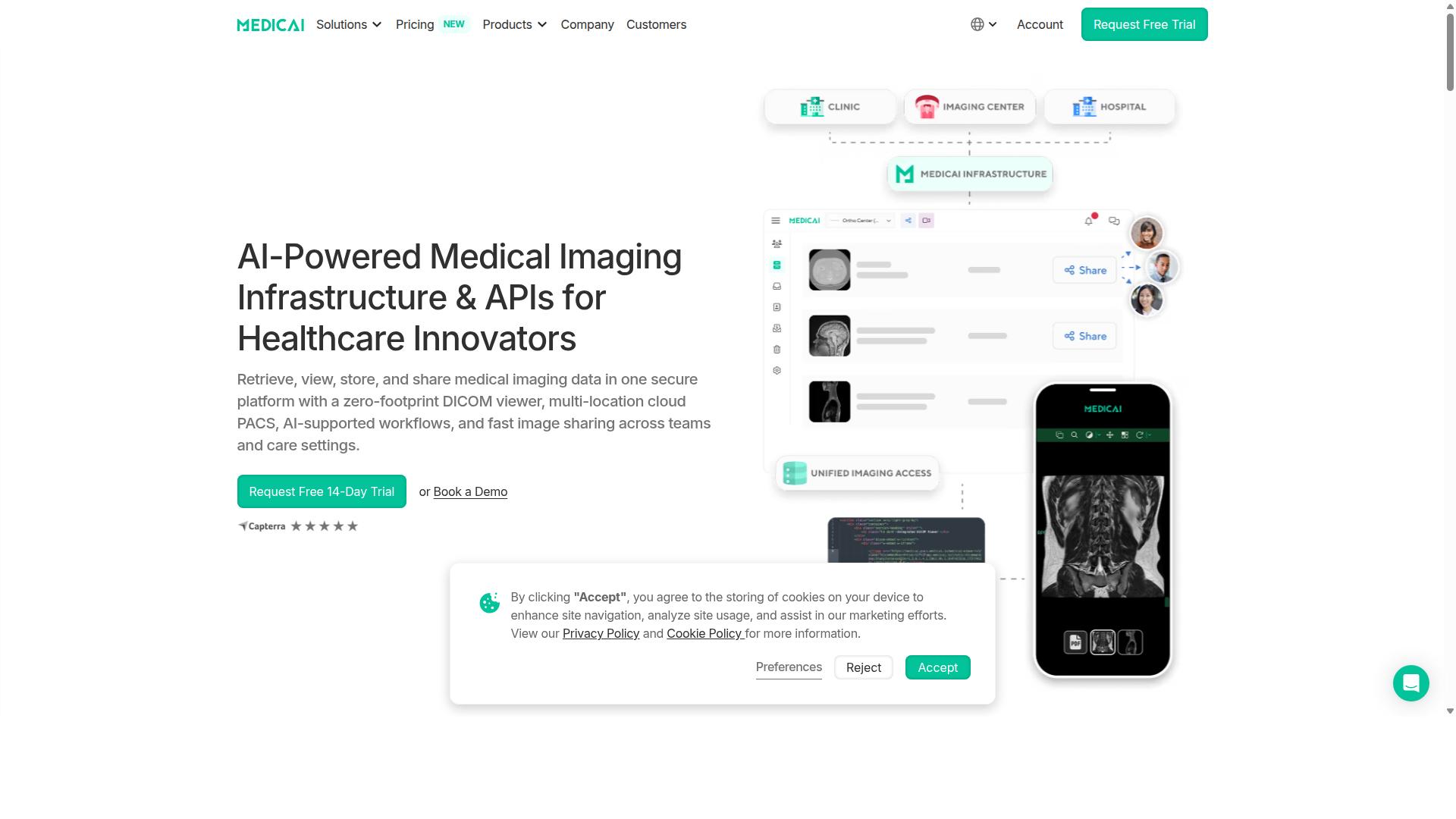
Medicai is a cloud-native medical imaging platform that lets providers retrieve, view, store, and share DICOM studies from any browser without installing software.
The zero-footprint viewer eliminates device-specific downloads. Healthcare teams access studies through standard web browsers on phones, tablets, or laptops while maintaining diagnostic quality across different screen sizes.
HIPAA and GDPR compliance protects patient data throughout storage and transmission. FDA and CEE clearance confirms the platform meets regulatory standards for medical device software in approved regions.
Availability in over 190 countries makes Medicai suitable for international referral networks and cross-border teleradiology. The platform supports multi-location cloud PACS that connects separate facilities under one secure system.
Scale indicators include 1.7 million studies stored and 50 million API transactions processed. These numbers demonstrate capacity for high-volume environments where mobile access and rapid image sharing matter most.
Imaging Infrastructure as a Service lets organizations avoid on-premise hardware maintenance. AI-supported workflows help prioritize studies and flag urgent cases for faster review on mobile devices.
What Is Tricefy?
Tricefy is a cloud PACS designed mainly for ultrasound practices. It focuses on secure image and report sharing with patients and referring physicians.
The platform serves as an ultrasound-oriented cloud archive and patient portal. Practices use it to manage medical imaging workflows that require consistent access across multiple locations.
Users interact through a web-based interface that supports image viewing on various devices. The system allows referring physicians to receive studies without needing specialized software installations.
Patient engagement happens through a dedicated portal where individuals can view their imaging results. Referring doctors gain access to studies through secure links sent via email or messaging systems.
The service addresses radiology workflow needs by storing DICOM files in the cloud. This approach supports teleradiology scenarios where radiologists review studies from different locations.
Many ultrasound practices choose such solutions when they need basic study sharing capabilities. The focus remains on straightforward image access rather than advanced diagnostic tools.
Security features include standard encryption methods and access controls typical for medical imaging platforms. Compliance requirements such as HIPAA guidelines shape how the system handles patient data.
Features Compared
Side-by-side analysis of the mobile-first capabilities each platform offers radiologists and referring physicians.
Both solutions address the need for instant study access outside hospital walls. The comparison focuses on viewer performance, upload and exchange workflows, and AI-enabled reporting.
Key differences appear in storage capacity, AI integration breadth, and multi-site coordination tools.
Zero-Footprint DICOM Viewer for Mobile
Medicai's browser-based viewer loads studies instantly on any smartphone or tablet with no app install, maintaining full diagnostic quality.
During the past year the viewer delivered 300 k visualizations and processed over one million studies. This volume indicates proven reliability under real clinical loads.
Tricefy also provides browser access. No comparable usage figures are published for that platform.
Zero-footprint design removes installation barriers for referring physicians who rarely open imaging workstations. Mobile diagnostic quality stays intact because the viewer streams full-resolution DICOM data without local caching.
Cross-platform support covers current iOS and Android versions. Bandwidth optimization adjusts image compression on the fly so studies open quickly even on cellular networks.
Cloud PACS & Image Exchange on Mobile Devices
Both platforms allow secure study upload and exchange from iOS/Android, but Medicai's Vendor Neutral Archive and gateway architecture accelerate multi-site workflows.
Medicai includes the Medical Imaging Uploader, DICOM Gateway, and 2 TB standard-tier cloud storage. One-click referrals move studies between locations without manual file handling.
Tricefy offers similar upload and sharing functions. Specific storage allocations for Tricefy are not publicly detailed.
Secure messaging and access control keep patient data protected during transit. Automatic audit trails record every view or transfer for compliance reviews.
The Medical Image Exchange service supports both physician-to-physician and patient-facing portals. Real-time collaboration lets multiple specialists comment on the same study from separate devices.
AI-Supported Workflows & Structured Reporting
Medicai integrates AI partners such as Rayscape.ai and MD.ai for automated measurements and structured reports accessible on mobile.
Additional partnerships with OHIF supply open viewer extensions that embed AI results directly into the diagnostic interface. Radiologists receive annotated images and pre-filled measurements within the same mobile session.
Tricefy's reporting tools focus on ultrasound workflows. Broader AI annotation features are not described in current public materials.
Structured Reporting for Radiology produces consistent templates that travel with the study across EMR systems. Report generation occurs on the server, so finished documents appear instantly on any connected device.
These integrations reduce repetitive tasks and shorten turnaround time for referring physicians waiting on results.
Pricing Compared
Medicai's transparent monthly tiers start at $249 for 500 GB and $749 for 2 TB, while Tricefy pricing is quoted on request. This structure gives prospective users immediate clarity without lengthy sales conversations.
Both plans include unlimited user accounts, which supports growing medical teams without extra per-seat fees. Users can access the full feature set during a 14-day trial that requires no credit card.
Yearly billing offers 15 percent savings, bringing the Starter plan to $209 monthly and Standard to $639 monthly when paid annually. This option suits practices that can commit to longer terms.
Enterprise customers can choose custom cloud storage with multiple connected locations or opt for per-study pricing. The one-time DICOM Gateway setup fee remains $1,000 per location regardless of plan tier.
Tricefy's closed pricing model requires direct outreach for any cost comparison. This difference in transparency may influence practices that prefer to evaluate total ownership costs quickly when selecting cloud PACS solutions for mobile access.
Who Should Choose Medicai
Hospitals, imaging centers, and multi-specialty groups needing enterprise-grade mobile DICOM access and scalable storage should select Medicai.
These organizations benefit from a platform that supports diverse clinical specialties while maintaining strong mobile capabilities. The platform serves radiology, cardiology, oncology, orthopedics, neurology, and OB-GYN practices through a single cloud PACS system.
Multi-specialty groups find value in the platform's ability to handle different imaging workflows across departments. A hospital network can route studies to the appropriate specialists without requiring separate systems for each specialty.
Imaging centers with high study volumes particularly benefit from the platform's storage capacity. The system currently manages 1.7 million studies across its infrastructure, demonstrating its ability to handle substantial data loads.
Global availability makes Medicai suitable for healthcare providers operating across different regions or time zones. Teleradiology services and telemedicine platforms can access studies from any location with internet connectivity.
Virtual care providers and clinical trial coordinators also find the platform meets their needs for secure medical imaging access. The patient portal extends these capabilities to patients who need to view their own imaging results.
Specialty care providers such as ophthalmology, pulmonology, dentistry, and gastroenterology practices can utilize the same platform as larger hospital systems. This creates consistency for organizations that span multiple care settings.
Medical education organizations and tumor boards benefit from the platform's ability to facilitate image sharing among multiple stakeholders. Personal injury lawyers can also access necessary imaging for their case work.
Who Should Choose Tricefy
Smaller ultrasound clinics and private practices seeking a lightweight cloud archive for patient and referrer sharing may prefer Tricefy. Many smaller facilities select this option when they need basic image storage without complex setup requirements. The focus remains on straightforward sharing rather than extensive workflow tools.
Practices with limited staff often find value in simplified platforms that avoid lengthy training periods. This approach works well for locations that handle straightforward ultrasound studies and need quick patient access. The system supports essential sharing functions for referrers who require basic image viewing capabilities.
Clinics that prioritize minimal technical overhead may lean toward this type of solution. When mobile access needs remain modest and the primary goal involves patient sharing, Tricefy offers a practical starting point. The platform handles core functions like study storage and basic sharing without additional complexity.
Organizations that expect to grow beyond basic needs should evaluate their long-term requirements. As patient volumes increase or workflow demands expand, more comprehensive platforms typically provide better scalability. The transition from basic sharing to full radiology workflow integration becomes more challenging with limited systems.
Research suggests that facilities requiring advanced mobile access features often outgrow basic archives quickly. When diagnostic quality viewing, EMR compatibility, and secure messaging become priorities, the limitations of lightweight solutions become apparent. Multi-device support and bandwidth optimization also factor into these decisions for growing practices.
Final Verdict
For teams prioritizing mobile diagnostic quality, global reach, and proven scale, Medicai's FDA-cleared, zero-footprint platform with 1 M+ studies processed yearly is the stronger choice.
Medicai stands apart through three key metrics. The platform has delivered 300 k visualizations and 50 M API transactions while maintaining HIPAA, GDPR, and FDA compliance across every region served. These numbers reflect both technical capacity and regulatory readiness.
Worldwide access means clinicians can review studies on any device without local software. Tricefy may suit smaller practices that need basic image sharing. Yet teams handling larger volumes or multi-site workflows often find Medicai's infrastructure more reliable.
Medicai USA is located at 7901 4th St N, STE 300, St. Petersburg, FL, 33702 and can be reached at +1 (832) 220 1035. Medicai Romania operates from 53-55 N Filipescu, 5th Floor, Sector 2, Bucharest, 020961 with phone +40 316 305 875. Inquiries may also be sent to [email protected].
Recommended Resources: