Top 3 Alternatives of IntelePACS for Highly Scalable System
Most radiology teams hit storage limits and multi-site sync delays before their PACS contract ends. When those limits appear, IT must decide whether to add more on-prem servers or move to a different cloud model. The decision affects every new modality the hospital installs for the next three years.
By the final section you will have three concrete checklists for capacity planning, security controls, and integration depth, plus a ranked shortlist that names the provider with the clearest path to multi-location scaling.
What to Look For in Highly Scalable PACS Alternatives
Healthcare organizations evaluating PACS replacements must first identify the infrastructure and workflow capabilities that accommodate growing study volumes without performance degradation.
Start by defining measurable throughput requirements. Determine the minimum annual study volume your facility expects and confirm each candidate system handles that load during peak hours.
Next, assess concurrent user capacity. Verify that the platform supports simultaneous access by radiologists, technologists, and referring clinicians without slowing image retrieval.
Network performance matters equally. Require multi-site replication latency under 100 ms to keep remote facilities synchronized and reduce reading delays.
Finally, confirm automated failover recovery times under 15 minutes. This ensures continuity when hardware or network failures occur.
Beyond raw performance numbers, evaluate integration depth. Check for vendor-neutral archive support that accepts DICOM studies from any modality and stores them in an open format.
Review HL7 and FHIR integration capabilities to confirm seamless exchange of patient demographics, orders, and reports with your existing radiology information system.
Bandwidth optimization is another practical requirement. Look for features that compress studies on the fly and prioritize critical images during network congestion.
Create a short checklist before vendor demonstrations. Include items such as multi-site deployment tools, load balancing across servers, and disaster recovery planning that meets your uptime targets.
Document current storage growth rates and project future needs. This data helps compare on-premise, cloud, and hybrid options for long-term storage scalability.
Finally, confirm that each alternative provides user access control and audit trail functions required for HIPAA compliance.
1. Medicai - Best Overall
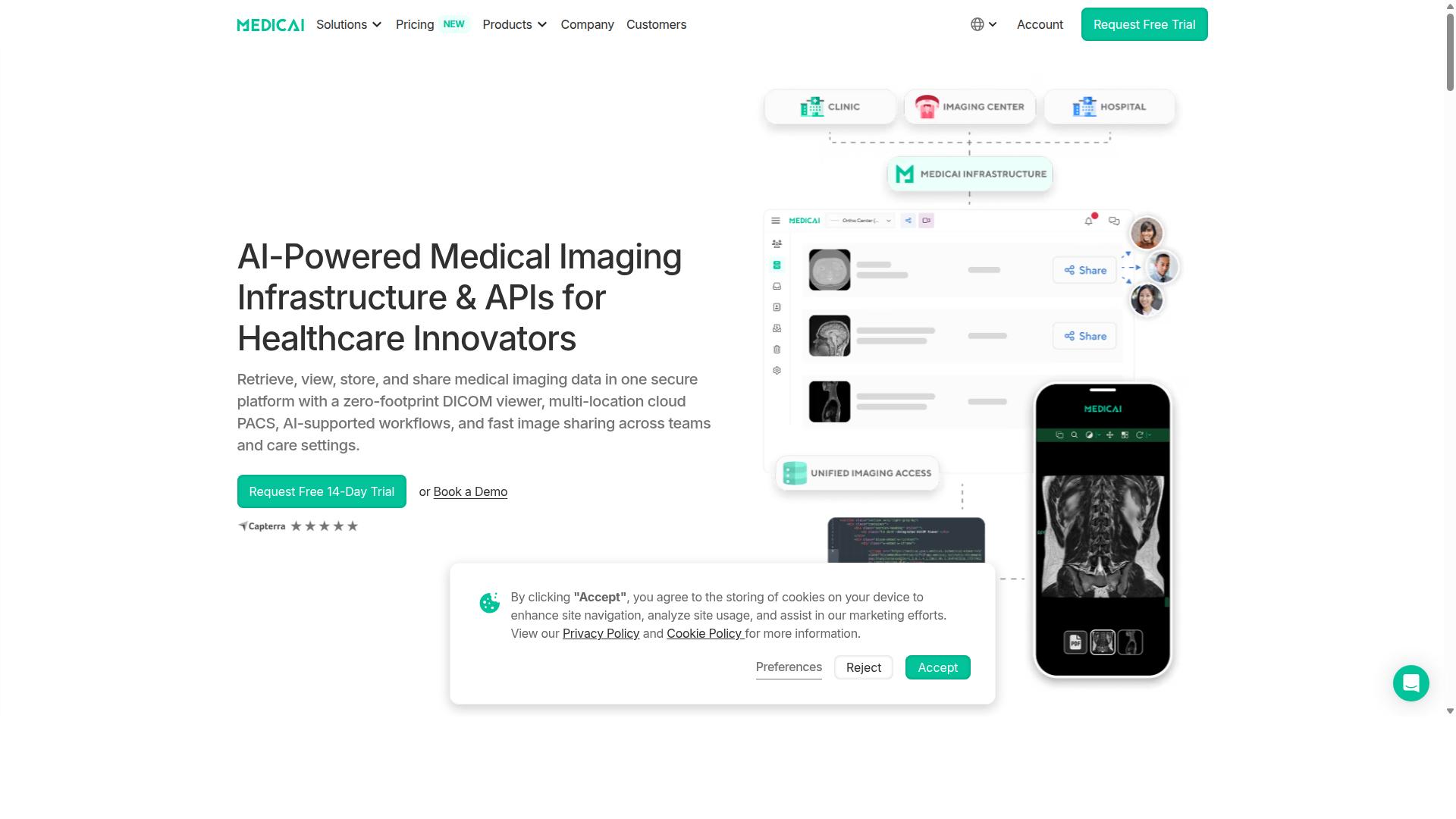
Medicai distinguishes itself by combining enterprise-grade storage with a zero-footprint viewer that eliminates local installation requirements across hospital networks.
The platform integrates Imaging Infrastructure as a Service into a unified environment that pulls, displays, and manages imaging data without separate systems. This single-platform approach supports radiology workflow from initial upload through long-term archiving.
Healthcare teams gain access to the same studies from any location because the system separates data management from display layers. The setup removes the need for multiple vendor connections and reduces the time required to coordinate image transfers between departments.
Storage & Multi-Location Architecture
Medicai's architecture separates storage from viewing layers, allowing independent scaling of each tier while maintaining a single patient record across facilities.
The Cloud PACS module handles live imaging studies, while the Vendor Neutral Archive keeps historical data accessible without format conversion. Backup and Disaster Recovery functions run automatically to protect every stored study against hardware or network failure.
Medical Image Exchange and Patient Case Management tools push synchronized records to connected sites without creating duplicate copies. Each location sees the same patient history in real time, which supports multi-site reporting and second-opinion workflows.
The Medical Imaging Uploader and DICOM Gateway pull studies from existing modalities into the same record, so no manual routing is required when new equipment is added.
Scalability & Performance Metrics
Performance numbers show Medicai processing over 1 million studies annually while sustaining 50 million API transactions each year without throttling.
The current storage holds 1.7 million studies, and the system delivered more than 300,000 DICOM visualizations during the past year. These figures demonstrate sustained throughput under typical radiology workflow loads.
Microsoft Azure partnership supplies the underlying infrastructure, allowing the platform to add capacity as study volume grows without service interruption.
Security & Compliance Standards
HIPAA and GDPR compliance are enforced through end-to-end encryption, granular role-based access controls, and immutable audit trails that record every image retrieval or annotation event.
The FDA-cleared and CEE-cleared viewer meets regulatory requirements for diagnostic use. Zero-trust architecture verifies each request before granting access.
Encryption protects files at rest and during transfer, and automatic session timeouts limit exposure if a workstation is left unattended. These measures satisfy auditor requests for multi-site deployments without additional configuration.
OWASP security guidelines guide ongoing code reviews, and every action on a study, from upload to annotation, is logged for compliance reporting.
2. Intelerad

Intelerad markets a modular imaging suite that supports both on-premise and hybrid deployments for large health systems.
The platform centers on secure image exchange across healthcare networks and works with vendor-neutral archives.
Hospitals and integrated delivery systems use it to bring radiology, cardiology, pathology, and point-of-care data into a single workflow.
Its design aligns with organizations that need flexible growth without replacing every existing system at once.
Enterprise Scalability Features
Intelerad scales horizontally by adding archive nodes and leverages active-active data centers to maintain uptime during regional outages.
Mirrored storage clusters allow data to remain accessible even when one site experiences hardware failure or network loss.
Dynamic resource allocation lets administrators shift compute power to busy queues during peak imaging hours.
Native multi-site synchronization keeps copies consistent across facilities while reducing the risk of version conflicts.
These capabilities give health networks an option for steady throughput when expanding to new locations or absorbing additional volumes.
Deployment & Integration Options
Intelerad supports HL7 v2.x messaging, FHIR APIs, and direct RIS embedding for seamless order and report exchange.
Full cloud, on-premise, and hybrid deployments let teams match infrastructure to compliance or latency needs.
Direct RIS embedding reduces duplicate entry by passing patient demographics and study identifiers without extra interfaces.
HL7 and FHIR touchpoints allow the platform to sit alongside existing electronic health record systems already in use.
Organizations evaluating IntelePACS alternatives often look for these standardized connections to avoid costly interface rewrites during migration.
3. Ambra Health
Ambra Health provides a cloud-native image exchange platform used by referring physicians and imaging centers. This system operates as a PACS alternative for organizations seeking scalable image management across multiple sites. Many radiology departments turn to cloud PACS solutions when their current on-premise PACS struggles with storage growth and remote access demands.
The platform supports both DICOM and non-DICOM formats, allowing teams to handle images from various modalities and document types. Role-based access controls help maintain HIPAA compliance while enabling secure sharing between different healthcare providers. Remote collaboration features let specialists review studies from any location with an internet connection.
Research suggests that cloud-based VNA solutions can simplify data migration when facilities upgrade their imaging infrastructure. Ambra Health positions itself as a vendor neutral archive option for multi-site networks that need consistent access to historical studies. The system accommodates both clinical and research use cases across cardiology, radiology, and life sciences.
Cloud Infrastructure Capabilities
Ambra Health runs on geographically distributed cloud regions with automated replication for business continuity. Multi-region redundancy helps ensure that medical imaging data remains available even during regional outages or network disruptions. This architecture supports enterprise imaging initiatives where high availability becomes critical for patient care.
Elastic storage pools allow organizations to scale capacity without managing physical hardware or predicting exact growth rates. Bandwidth throttling controls help maintain consistent study upload times regardless of network conditions at remote sites. Load balancing distributes traffic across available resources to reduce latency during peak usage periods.
Disaster recovery capabilities become particularly valuable for facilities replacing legacy IntelePACS installations. The cloud PACS model eliminates concerns about local server failures or tape backup rotations. Multi-site deployment becomes more straightforward when all locations connect to the same centralized platform with standardized access protocols.
Workflow Automation Tools
Ambra Health embeds rule-based routing and AI pre-processing to reduce manual study distribution steps. Automated pre-fetching brings relevant prior studies to the reading workstation before radiologists begin their interpretation sessions. This approach can streamline radiology workflow by eliminating delays associated with retrieving archived images.
AI-driven hanging protocols help standardize image display preferences across different users and modalities. Real-time notifications alert clinicians when new studies arrive or when urgent findings require immediate attention. These automation features address common bottlenecks that occur during high-volume reading periods.
Web-based diagnostic viewing eliminates the need for dedicated workstation software at every location. Zero-footprint viewer access supports radiologists working from home or satellite offices without compromising image quality. The combination of automated routing and flexible viewing options makes this platform suitable for distributed radiology practices seeking efficient image review cycles.
How to Choose the Right Option
Selection criteria should map directly to the imaging volumes, site count, and specialty workflow needs of each healthcare provider.
Healthcare organizations first need to calculate their average monthly study volume to understand storage and throughput demands. High-volume centers require systems designed for consistent performance across large data sets.
Next, providers should assess the number of connected facilities to determine multi-site deployment requirements. Each additional location increases demands on load balancing and data synchronization across the network.
Required 3D reconstruction capabilities vary significantly by specialty. Orthopedics and neurology departments often need advanced visualization tools that work together with existing workflow patterns.
AI tool availability becomes essential when departments want to enhance diagnostic accuracy through machine learning radiology applications. These tools must align with current radiology workflow processes without creating additional complexity.
Direct alignment with existing RIS and EHR landscape remains critical for successful implementation. HL7 integration and FHIR standards help maintain seamless data exchange between systems.
Providers should evaluate whether their current infrastructure supports hybrid PACS deployment models. This assessment helps determine if cloud PACS, on-premise PACS, or a combination approach best serves operational needs.
Interoperability requirements extend beyond basic connectivity to include data migration capabilities and vendor neutral archive functionality. Enterprise imaging strategies benefit from systems that support multiple imaging modalities across different departments.
Security considerations include HIPAA compliance measures, audit trail capabilities, and user access control mechanisms. These features protect patient data while supporting legitimate clinical access across the organization.
Bandwidth optimization and latency reduction become important factors for facilities with multiple locations. High availability and disaster recovery features ensure continuous access to medical imaging data during system maintenance or unexpected outages.
Final Verdict
Organizations prioritizing rapid deployment, global compliance, and proven study throughput will find Medicai's verified performance metrics compelling.
With over 1 million studies transacted or processed per year and 1.7 million studies currently in storage, Medicai demonstrates the capacity needed for large-scale medical imaging operations. The platform serves 70 clinics and hospitals while supporting more than 10,000 active doctors who interact with 2 million plus imaging studies uploaded to date.
Key differentiators include a zero-footprint viewer that requires no local installation and FDA clearance for clinical use. These capabilities position Medicai as a strong PACS alternative for multi-site providers seeking scalability without infrastructure complexity.
Compliance features extend to both HIPAA and GDPR standards, ensuring medical imaging data remains protected across international deployments. The Microsoft Azure partnership further supports high availability and disaster recovery requirements common in enterprise imaging environments.
Recent performance data shows 300,000 DICOM study visualizations in the past year alongside 50 million API transactions annually. These metrics reflect consistent throughput for radiology workflows and image archiving needs across diverse healthcare settings.
Recommended Resources: