PostDICOM vs Medicai for Vendor-Neutral Archives
Your hospital needs a vendor-neutral archive that actually scales without surprise fees or format headaches. Many platforms cap storage after migration or force extra contracts when imaging volume spikes. Choosing between PostDICOM and Medicai now means locking in long-term cost and compliance before those limits appear.
By the end of this article you will know exact storage limits, API depth, and security certifications for each option, then see a clear recommendation on which archive fits your current volume and growth plan.
Quick Verdict: PostDICOM vs Medicai for Vendor-Neutral Archives
This quick verdict identifies which platform best suits healthcare providers seeking a vendor-neutral archive for medical imaging storage.
Medicai emerges as the clear winner based on HIPAA and GDPR compliance, global availability, and its capacity to handle 50M yearly API transactions.
Two concrete advantages set Medicai apart. First, the platform processes over 1M studies annually while maintaining full HIPAA and GDPR compliance for medical imaging data. Second, its Microsoft Azure partnership supports scalable deployment across multiple geographic regions.
PostDICOM faces a notable limitation for organizations that require high-volume data exchange. The platform lacks published benchmarks for API transaction capacity at the scale healthcare enterprises demand.
At a glance: how Medicai compares to PostDICOM, Medicai for Vendor-Neutral Archives on the features that matter most.
| Feature | Medicai | PostDICOM | Medicai for Vendor-Neutral Archives |
|---|---|---|---|
| Vendor-Neutral Archives | ✓ | — | — |
What Is Medicai?
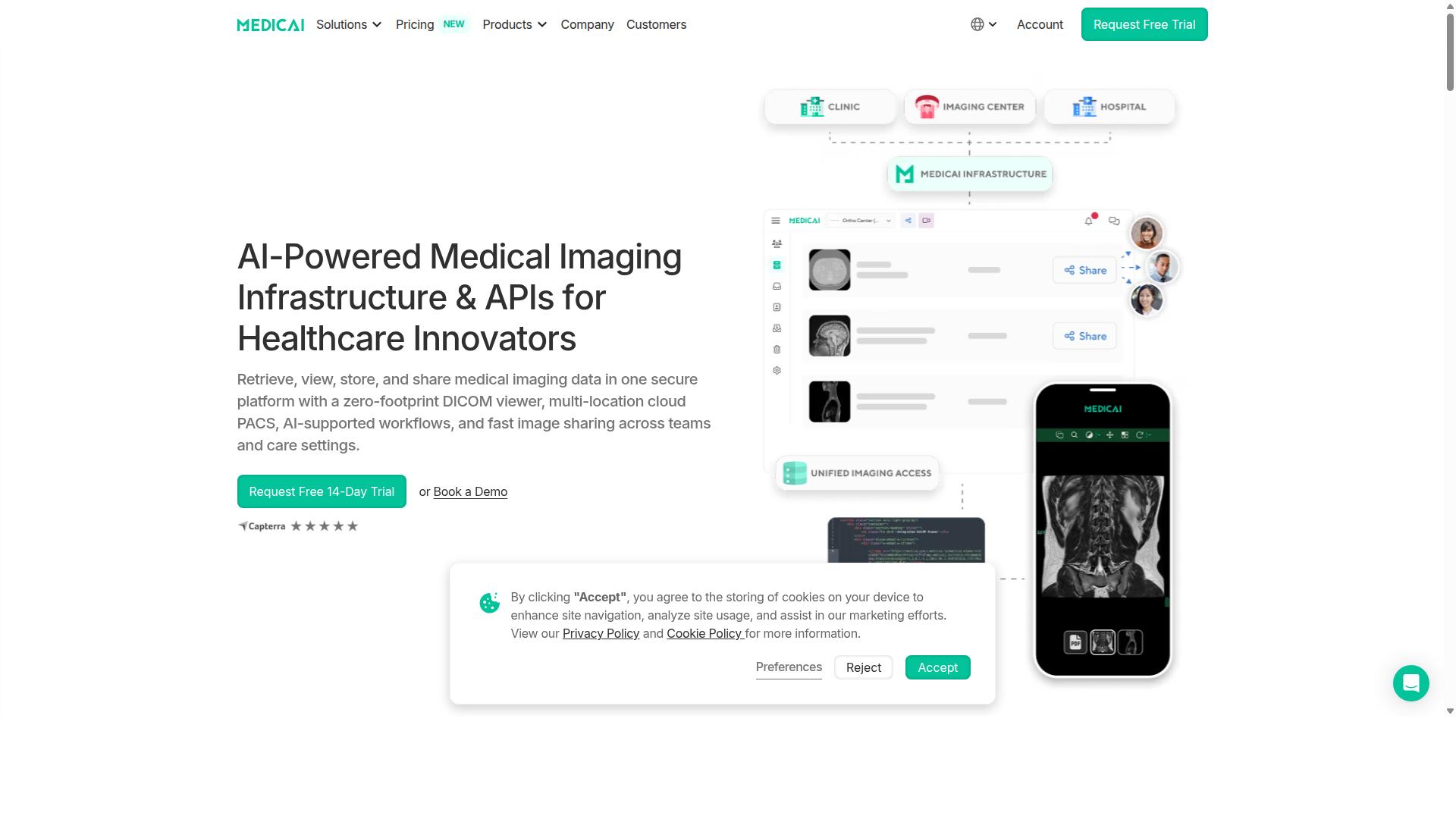
Medicai is a cloud-based medical imaging platform that lets providers retrieve, view, store, and share imaging data through a single secure portal. The platform includes a zero-footprint DICOM viewer, multi-location cloud PACS, AI-supported workflows, and fast image sharing across teams and care settings.
Healthcare organizations use Medicai as a Vendor-Neutral Archive solution that supports DICOMweb standards including WADO, QIDO, and STOW. The system integrates with existing EHR and RIS platforms through HL7 and FHIR protocols, creating a unified approach to medical imaging across different departments.
Medicai delivers Imaging Infrastructure as a Service that eliminates the need for on-premise hardware maintenance. The platform handles 1M+ studies per year while maintaining security standards for HIPAA and GDPR compliance through encryption and access control features.
The architecture supports scalability for growing imaging volumes without requiring additional infrastructure investments. Multi-tenancy capabilities allow different departments or facilities to maintain separate workflows while sharing the same underlying system.
What Is PostDICOM?
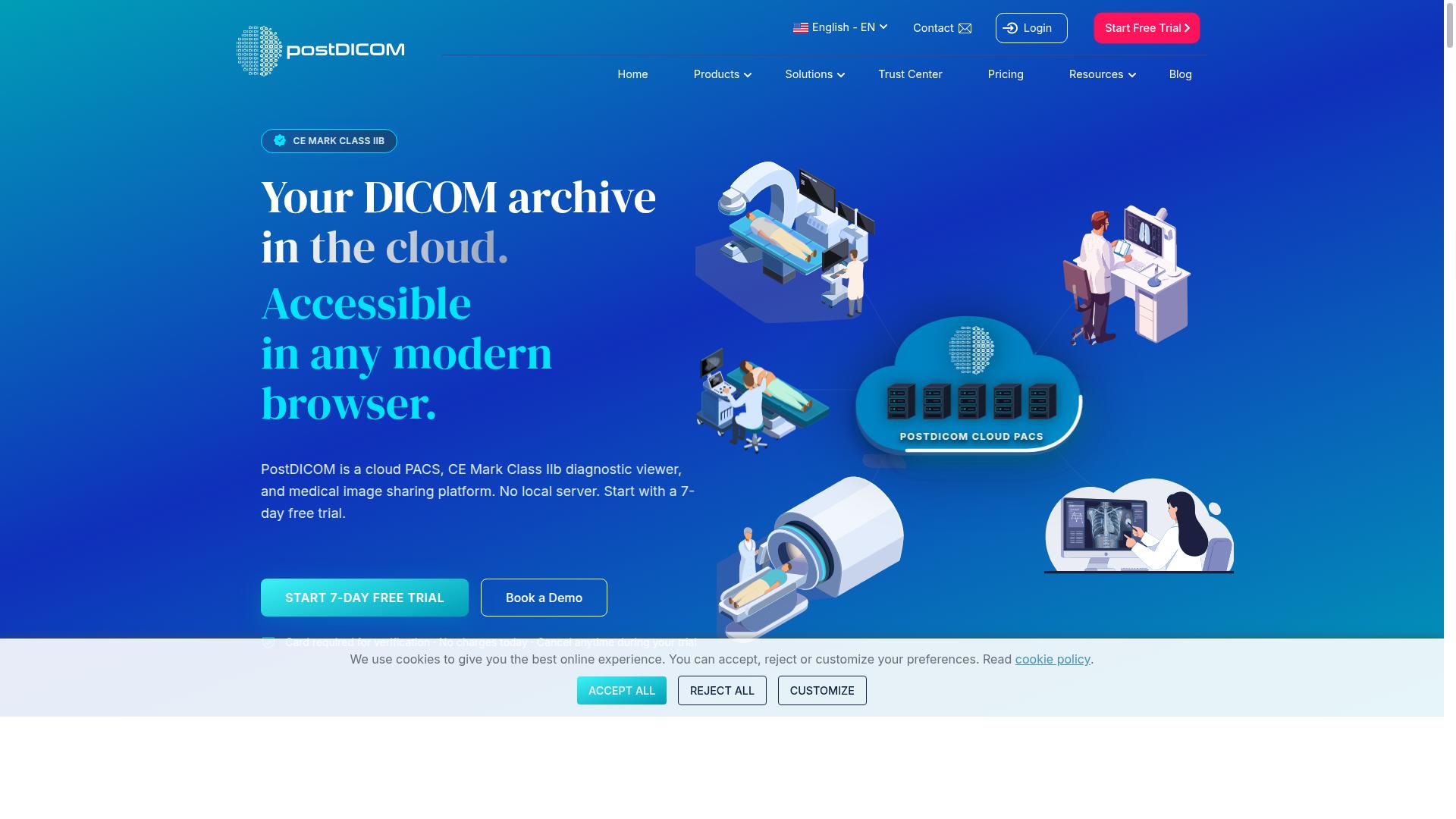
PostDICOM is a cloud-based PACS solution that offers DICOM storage, sharing, and viewing capabilities for medical imaging workflows. The platform addresses core needs around image archive management in radiology and other clinical environments. Users typically access the system through web browsers, which can reduce the need for local desktop installations.
Many organizations evaluate PostDICOM when they seek a solution for Vendor-Neutral Archive requirements. The service supports standard DICOM operations and may include options for data migration from legacy systems. Deployment models often center on cloud storage rather than on-premise infrastructure.
Healthcare facilities comparing PostDICOM to Medicai for VNA use cases should consider factors like interoperability with existing EHR and RIS systems. HL7 and FHIR compatibility can influence how smoothly imaging data flows between departments. Scalability and subscription pricing models also vary between these platforms, which affects long-term planning.
Key evaluation points include encryption methods, access control features, and audit log capabilities. Organizations must confirm HIPAA and GDPR compliance based on their specific regulatory environment. Multi-tenancy support may matter for practices that serve multiple sites or specialties.
What Is Medicai for Vendor-Neutral Archives?

As a vendor-neutral archive, Medicai stores imaging studies in a non-proprietary format that can be accessed by any DICOM-compliant system.
The Vendor Neutral Archive keeps medical imaging data independent from proprietary PACS systems. This approach supports long-term storage and simplifies data migration when organizations change equipment vendors.
Backup and disaster recovery features protect imaging studies through cloud-based replication. The system maintains copies across multiple locations to ensure availability during system failures or facility disruptions.
Patient Case Management modules organize studies with related clinical information. Providers can group imaging data with patient records for coordinated care across different departments and facilities.
These components work together within Medicai's STORE & MANAGE offerings. The platform combines Cloud PACS, Medical Image Exchange, and the Vendor Neutral Archive to support complete medical imaging workflows.
Features Compared
This section compares key functional areas that determine the effectiveness of each vendor-neutral archive.
VNA performance depends on storage infrastructure, security standards, and integration speed. Organizations evaluating these systems need clear differences in daily operation.
The following three areas directly influence how radiology teams manage growing imaging volumes and coordinate care across multiple sites.
Storage Capacity & Scalability
Storage capacity and scalability determine whether a VNA can handle growing imaging volumes without performance loss.
Medicai provides a Standard tier with 2 TB cloud storage and maintains 1.7M+ studies. This architecture supports multi-tenancy while keeping latency low during peak reading hours.
The system scales from single-location deployments to enterprise environments with multiple connected sites. Per-study pricing options accommodate facilities with variable imaging volumes.
PostDICOM follows a general cloud storage approach that does not specify detailed capacity tiers or multi-tenant performance benchmarks. Organizations seeking predictable throughput for large archives may need additional clarification on latency guarantees.
Compliance & Security Certifications
Compliance with data-protection regulations is mandatory for any medical imaging archive handling patient data.
Medicai maintains HIPAA and GDPR compliance, holds FDA/CEE clearance for its viewers, and follows OWASP security guidelines. The platform uses encryption protocols and maintains audit logs for access tracking.
These certifications allow healthcare organizations to meet regulatory requirements across different jurisdictions without additional security modifications.
PostDICOM addresses compliance in general terms without publishing specific certification details. Hospitals requiring documented audit trails and verified encryption standards may need to request additional documentation before deployment.
Integration & API Capabilities
Integration depth dictates how smoothly the archive exchanges data with EHR, RIS, and modalities.
Medicai processes 50M+ yearly API transactions and supports DICOMweb standards alongside REST API endpoints. This volume indicates reliable interoperability for busy radiology departments.
The platform connects with existing PACS systems and supports HL7 and FHIR messaging for seamless data flow between clinical applications.
PostDICOM describes integration capabilities in general terms without published transaction volumes or specific API specifications. Facilities requiring high-throughput connections may need to verify performance expectations during procurement.
Pricing Compared
Pricing models affect total cost of ownership and the ability to scale storage without budget surprises.
Medicai publishes clear monthly rates. The Starter tier costs $249 per month and includes 500 GB of cloud storage plus unlimited user accounts. The Standard tier runs $749 per month and provides 2 TB of storage with one connected location.
Yearly billing reduces these rates by 15 percent. Starter drops to $209 per month when paid annually, while Standard falls to $639 per month. A 14-day trial lets teams test Starter features without entering payment details.
Enterprise customers receive custom pricing based on storage needs and the number of connected locations. A one-time $1,000 fee covers DICOM Gateway setup at each new site.
PostDICOM lists general subscription options on its site, though exact storage limits and location fees are less clearly stated. This approach can leave budgeting decisions less predictable for growing practices.
Teams evaluating a Vendor-Neutral Archive often compare these published rates against broader vendor quotes. Transparent tiers help practices forecast costs as study volumes rise over time.
Who Should Choose Medicai
Certain healthcare organizations gain the most value from Medicai's combination of compliance, scalability, and global reach.
Hospitals handling large imaging volumes benefit from extended storage capacity. Organizations processing over 1.7 million studies find the platform supports sustained data growth without infrastructure concerns.
Imaging centers that serve multiple referring physicians need reliable access for their network. Centers generating more than 300,000 visualizations each year require consistent performance across various medical specialties.
Specialty providers in orthopedics, neurology, and oncology often coordinate care across different sites. These groups rely on a Vendor-Neutral Archive that maintains compatibility with existing PACS and EHR systems.
Radiology and cardiology departments need fast image retrieval for time-sensitive cases. Their daily workflows depend on quick access to studies from multiple modalities without delays.
Healthcare organizations that operate across regions benefit from a cloud-based solution. The platform supports multi-site collaboration while meeting regulatory requirements for data protection.
Who Should Choose PostDICOM
PostDICOM may suit providers whose priorities differ from Medicai's strengths. Certain facilities place a higher value on self-managed systems or specific deployment preferences that align with their existing internal resources. In these cases, the choice often depends on how an organization balances control against convenience.
Some radiology departments prefer solutions that allow full on-premise deployment without reliance on external cloud services. Others may need a Vendor-Neutral Archive that integrates with legacy PACS systems through older protocols. These needs can make PostDICOM appear more suitable for specific technical environments.
Smaller practices with limited imaging volumes sometimes prioritize different cost structures. When budgets are tight and data migration requirements remain modest, a simpler VNA option may meet basic image archive needs without additional platform capabilities. The decision ultimately rests on matching the tool to the scale and complexity of each facility's workflow.
Who Should Choose Medicai for Vendor-Neutral Archives
Organizations planning long-term, vendor-independent image archiving should evaluate Medicai's VNA-specific capabilities. Many facilities face the challenge of consolidating imaging data from multiple sources while maintaining interoperability across different vendors. A true Vendor-Neutral Archive provides the foundation for this consolidation.
Facilities that require data migration from legacy systems benefit from Medicai's structured approach to moving imaging data. The image archive capabilities allow institutions to store DICOM studies in a central repository without being locked into any single vendor. This flexibility proves essential when departments need to integrate new modalities or replace aging PACS systems.
Multi-system access becomes critical for organizations running several imaging departments or serving multiple locations. DICOMweb protocols enable secure retrieval and exchange of medical images across different applications and platforms. This capability supports the broader goal of achieving true interoperability between systems.
Medicai offers a Cloud PACS and Vendor Neutral Archive as part of its STORE and MANAGE services. These tools work together to provide both immediate access and long-term storage solutions. The Medical Imaging Uploader and DICOM Gateway simplify the process of connecting existing modalities and legacy systems to the archive.
Healthcare providers seeking multi-system access can rely on the Medicai Imaging API to connect with existing EHR and RIS platforms. The Doctor Imaging Portal and Patient Imaging Portal extend access to authorized users while maintaining security standards. Facilities that need both on-premise and cloud deployment options find these capabilities align with their infrastructure requirements.
Final Verdict
The final verdict weighs compliance, scalability, API volume, and pricing to recommend the stronger vendor-neutral archive. Medicai stands out with 1M+ studies transacted or processed per year and 50M+ yearly API transactions that support large-scale radiology workflows.
Its global reach extends across 70 clinics and hospitals with 10,000+ active doctors accessing medical imaging data. This level of adoption demonstrates proven scalability for complex multi-site environments.
PostDICOM offers basic vendor-neutral archive functions for smaller deployments. Organizations with high API demands, strict HIPAA and GDPR requirements, or need for Microsoft Azure partnership infrastructure typically select Medicai.
Teams seeking straightforward on-premise setups with limited interoperability needs may find PostDICOM sufficient. The decision hinges on whether the practice requires 1.7M+ studies in storage capacity and extensive DICOMweb connectivity moving forward.
Recommended Resources: